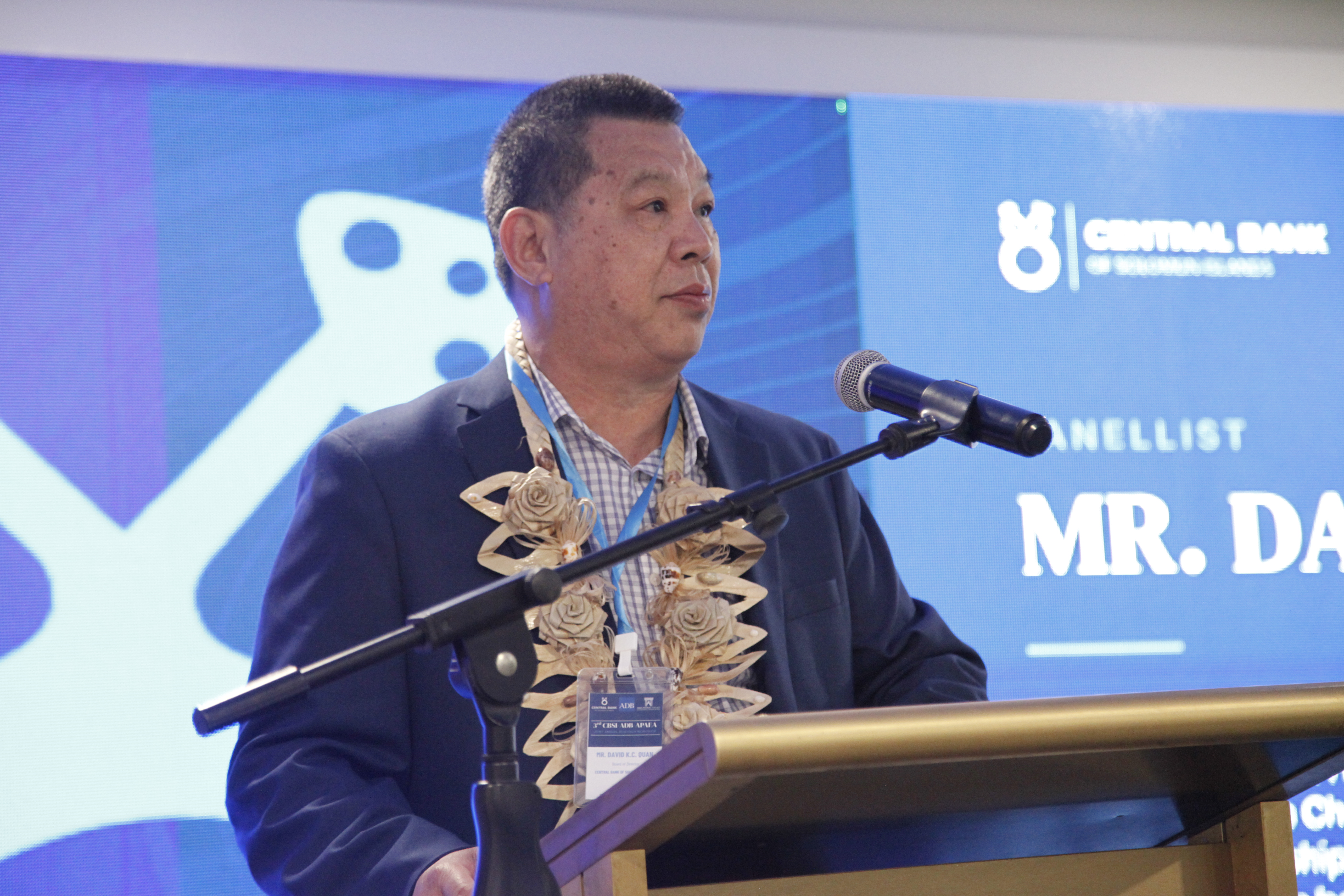
3rd Central Bank of Solomon Islands — Asian Development Bank– Asia-Pacific Applied Economics Association (APAEA) Joint Annual Research Workshop.
Presented by Acting Governor Mr. David K.C. Quan, OBE Tuesday, 27th October 2026, 9:25-9.30 AM Venue: A’hara and Nahona Conference Room, Heritage Park Hotel
Salutations:
The Hon. Min. of Finance and Treasury, Hon. Rexon Ramofafia; Professor Paresh Narayan, President of the Asia-Pacific Applied Economics Association (APAEA); Dr. John Beirne, Principal Economist, Asian Development Bank (ADB); Heads of Government Ministries and Government Representatives; Representatives of donor partners; Heads of Financial Institutions and representatives from the private sector; Heads and Representatives of Academic institutions; Distinguished Participants; Ladies and gentlemen:
Good morning, everyone,
It is a great pleasure to welcome you to the 3rd CBSI-ADB-APAEA Joint Annual Research Workshop. I extend a warm welcome to our speakers, discussants, participants, and especially those who have travelled from overseas to be with us here in Honiara, and those who will join us online. We greatly appreciate your presence and the expertise you bring to this workshop. I would also like to acknowledge the Honourable Minister of Finance and Treasury, our Guest of Honour, and thank him for taking the time to officially open this conference. We are honoured by your presence and deeply appreciate your support for this important event. I also want to acknowledge the Acting Governor of the Reserve Bank of Vanuatu.
Thank you for joining us. It is an honor to have you here. Significance of Conference Theme: Ladies and gentlemen, our theme this year, "Navigating Global Economic Shocks: Monetary Policy, Exchange Rate Dynamics, and Macroeconomic Stability in Small Open Economies," is indeed both timely and highly relevant. We continue to operate in an uncertain global environment. Geopolitical tensions in the Middle East, disruptions to global supply chains, higher global oil prices, and frequent climate-related events, including the impact of El Niño, are reshaping the economic and financial landscape. For small open economies such as the Solomon Islands, these developments are not distant events. They quickly reach us through their impact on trade, exchange rates, domestic prices, and ultimately household and business costs. Recent tensions in the Middle East demonstrate how quickly global shocks can reach our shores. The impact is already evident in Honiara fuel prices, which rose to an average of SBD12.87 per litre in October from $9.54 per litre in December last year. This highlights the vulnerability of small, import-dependent economies to global energy shocks and the challenge they pose for policymakers. We must preserve macroeconomic and financial stability while also creating conditions that support sustainable economic growth.
Over the course of this workshop, we will explore many of these issues. The papers and discussions will cover exchange rate dynamics and trade adjustment, exchange rate pass-through to inflation, financial sector efficiency, international capital flows, and the wider implications of global shocks for small economies in the Asia-Pacific. These are not simply academic questions. They are policy questions with very practical consequences.
This brings me to the importance of research. Research is valuable, but research alone does not solve problems. Too often, good ideas remain in reports and journals without influencing the decisions we make. The challenge for all of us is to ensure that research is relevant, practical, and connected to the realities facing our economies. This is especially important today, as the global economy faces growing uncertainty from geopolitical tensions, trade disruptions, higher oil prices, climate-related shocks, and rapid technological change. For Solomon Islands, many of these challenges originate beyond our borders and are largely outside our control. While we cannot prevent these shocks, research can help us better understand their implications and develop more effective policy responses. This workshop provides an opportunity to strengthen that connection between research and practice by bringing together researchers, policymakers, and practitioners to exchange ideas, challenge assumptions, and learn from one another.
This workshop reflects the value of partnership. While CBSI, ADB and APAEA provide the foundation for this event, its success also depends on the diverse expertise represented in this room. Researchers, policymakers, development partners, industry representatives and practitioners all have an important role to play in ensuring that research remains relevant to the challenges facing Solomon Islands. I look forward to this afternoon's discussions on global energy prices and El Niño, where we can draw on both research and practical experience to better understand these challenges and explore possible policy responses.
Ladies and gentlemen, I encourage you to make the most of today’s workshop. Ask questions. Challenge ideas respectfully. Share your own experiences and perspectives. And take the opportunity to connect with people you may not normally have the chance to engage with. A successful research conference should not end when the final presentation is completed. I hope the conversations started here today will lead to new research questions, stronger professional networks, deeper institutional partnerships and, ultimately, better policies. If we can achieve that, then this workshop will have made a meaningful contribution not only to our institutions, but to the broader goal of building more resilient and prosperous economies across Solomon Islands and the wider Pacific.
In closing, navigating a period of considerable economic uncertainty requires sound analysis, informed policy, and strong partnerships. Research has a part to play in all three. So let us use this workshop to turn good research into ideas that make a practical difference. I wish you all a productive and rewarding workshop.
Tagio tumas.